Synthetic Users
Testing whether synthetic audiences could improve creative decisions before media spend.
Context
Save the Children invests significantly in digital acquisition, but campaign performance was becoming harder to predict. Much of the learning happened after creative went live and media budget was committed. I wanted to test whether we could move some learning earlier.
My Role
As Innovation Lead, I identified and led the experiment with Acquisition and Insight colleagues. I helped define the use case, ground synthetic profiles in real audience data and insight, design testing, work with marketing on live validation, and turn learning into a repeatable process.
Problem
Digital campaigns often generate learning after creative has gone live and media budget has been committed. I wanted to test whether AI-generated audience profiles could move some learning earlier, creating a cheaper sandbox before launch.
Approach
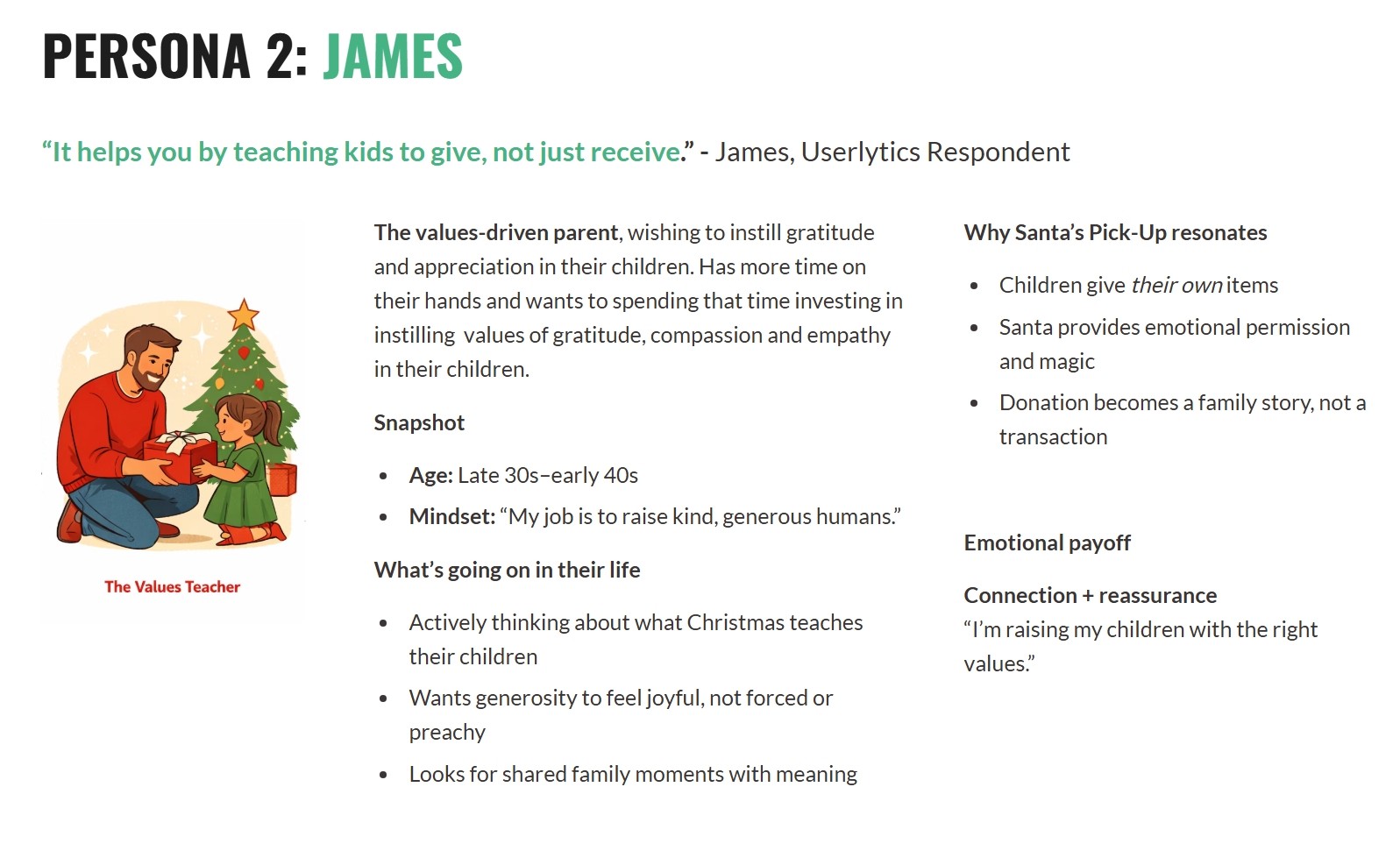
We built synthetic audience profiles grounded in customer behaviour and insight, then used them as an additional experimentation layer before live media tests. For Christmas Jumper Day, we compared 10 advertising concepts against sign-up intent, memorability and appeal. “Sign up in two minutes” performed strongly by reducing effort; “Help change children’s lives” was the strongest purpose-led message. Organiser packs and free resources, and social proof, also performed well. Large party messaging was polarising; clever slogans could be liked without increasing intent. Liking is not the same as acting.
Experiments / Evidence
We took the learning into live campaigns with real audiences. Early live validation showed that ad sets tested through the synthetic-user process before launch performed on average around 32% better than those not pre-tested, with lower CPC and CPA.
Outcome
The experiment showed synthetic audiences could add a useful learning stage before media investment. I worked with the team on a business case and playbook; the methodology was subsequently embedded in campaign development rather than remaining a one-off experiment.
What I Learned
Synthetic audiences can make experimentation faster and cheaper, but they are not a substitute for real customers. Models can produce convincing answers that reflect what they expect a researcher wants to hear. Use AI to learn cheaply, then use real behaviour to test whether that learning is true.