Santa’s Pick-Up
Doorstep collection made Christmas donations easier for families and opened a new fundraising proposition.
Uncertainty → insight → proposition → experiment → evidence → decision
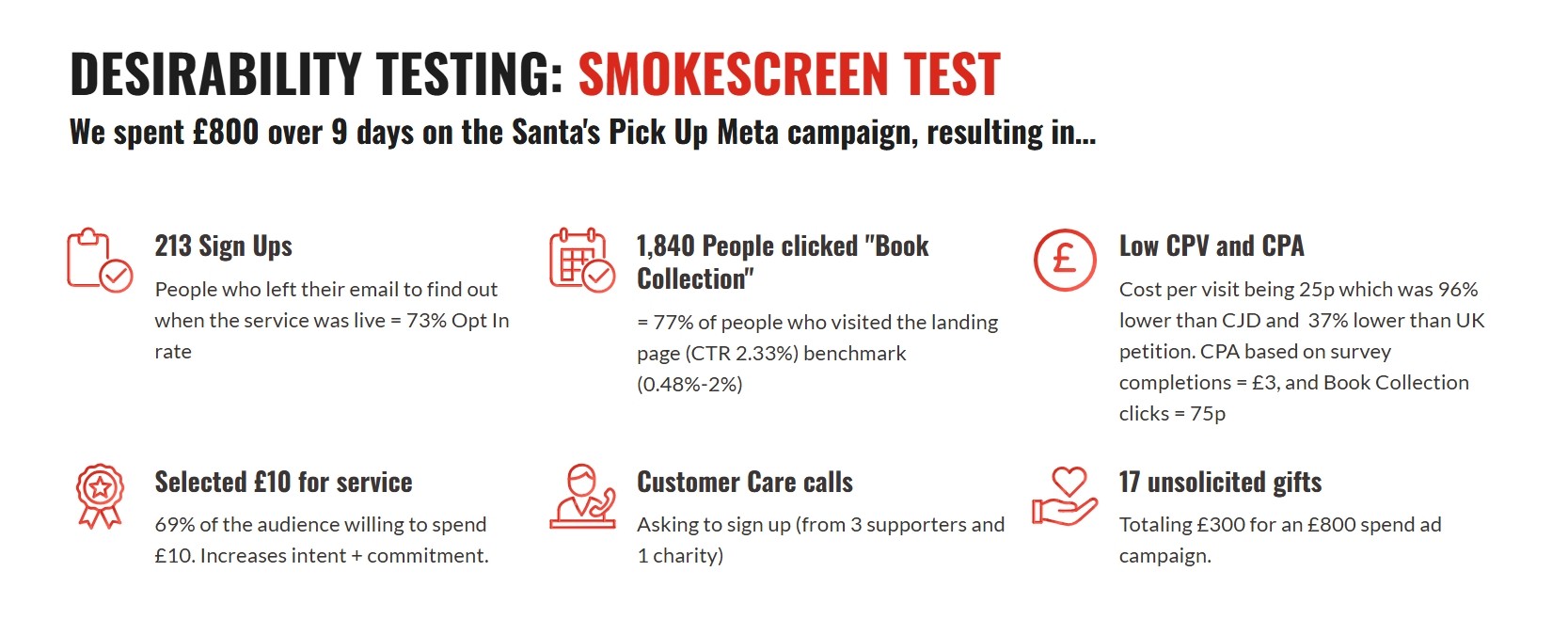
1,840
Book Collection clicks
213
sign-ups
69%
selected £10 as a fair price
2.33%
Meta CTR
70.7%
of clicks chose Santa’s Pick-Up alongside competing propositions
9 days
from campaign launch to meaningful behavioural evidence
Context
The brief asked how Christmas generosity could create ongoing support, unrestricted income and emotional connection, ideally through regular giving, for an affluent or upwardly mobile Millennial Big Picture audience. Research challenged that assumption: 97% of people surveyed or interviewed rejected regular giving at Christmas. Giving was more often tangible, ritualistic and one-off, amid cost, waste, commercialisation and seasonal mental load. Other signals: 67% of under-35s agreed with family or friends not to exchange gifts; 46% of the public planned to donate goods to charity. Discovery covered 15 interviews, ~250 people across 8 surveys, 100 campaigns, 7 internal and 6 expert interviews, 3 workshops and 4 specialist tools.
My Role
As Innovation Lead, I led the opportunity from discovery through proposition development, behavioural validation and commercial and partner feasibility. I coordinated audience research, internal and senior-leadership alignment, concept testing, acquisition, analytics, operational partners and modelling to build evidence for a stage-gate decision.
Problem
“We help you declutter in time for Christmas
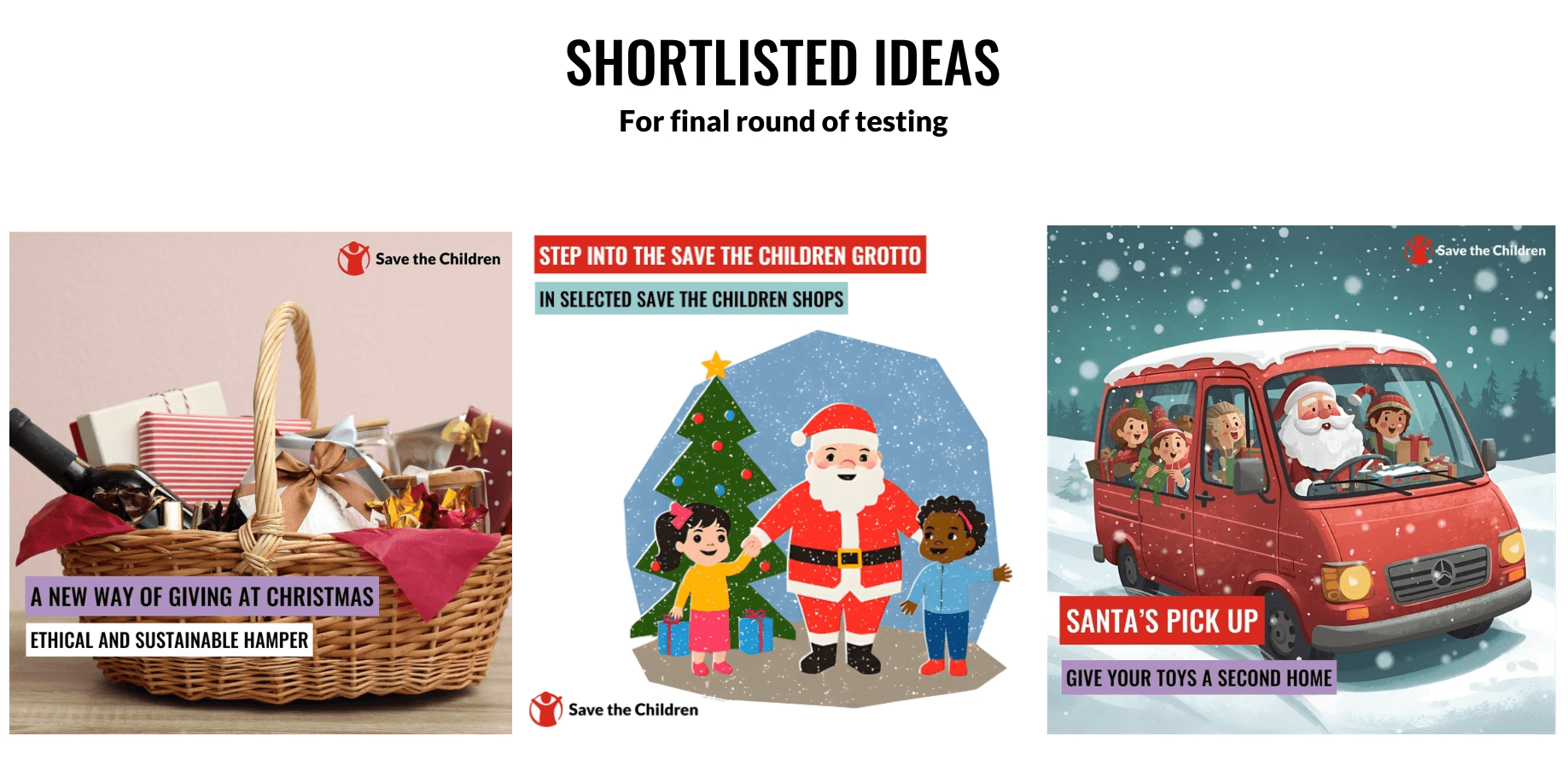
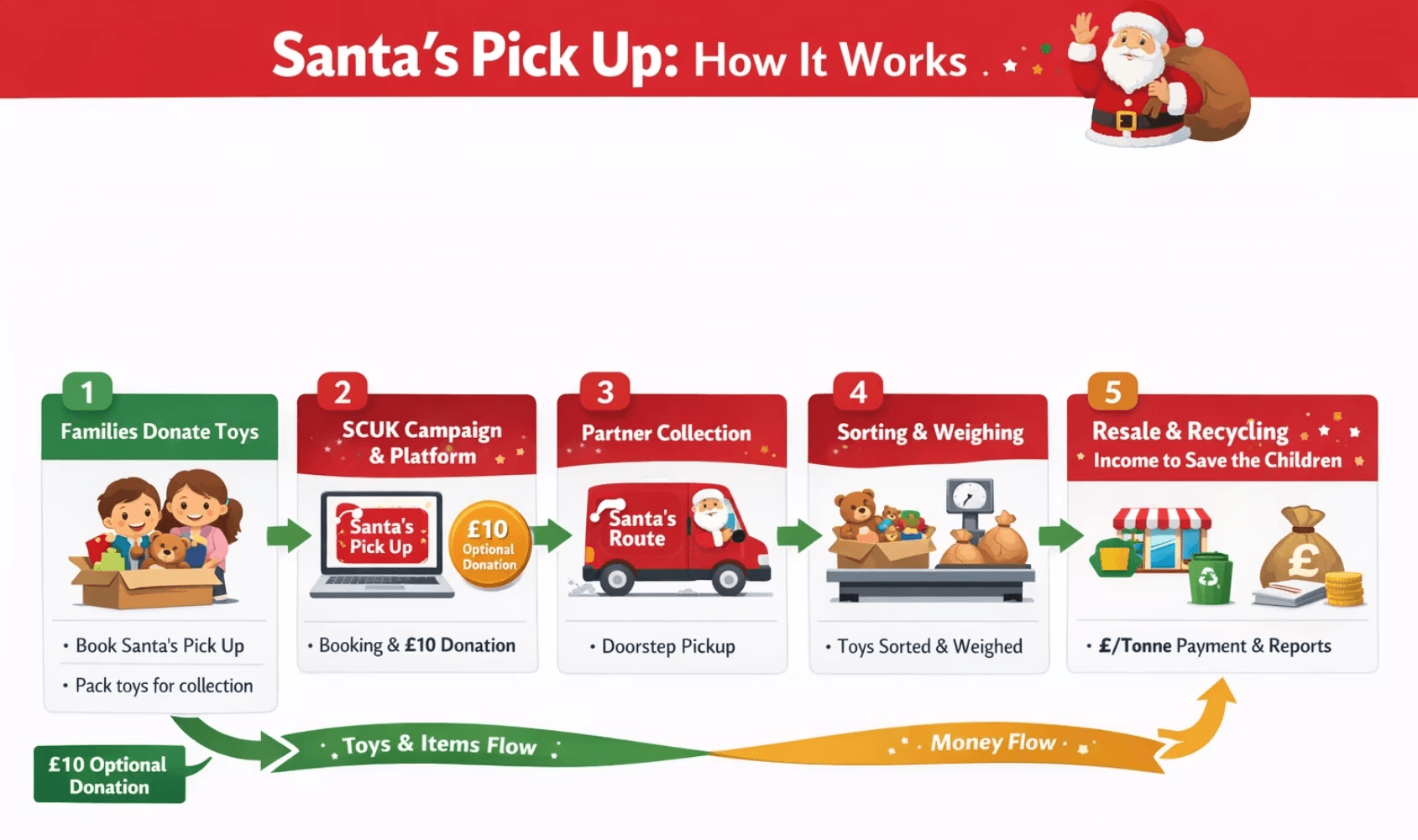
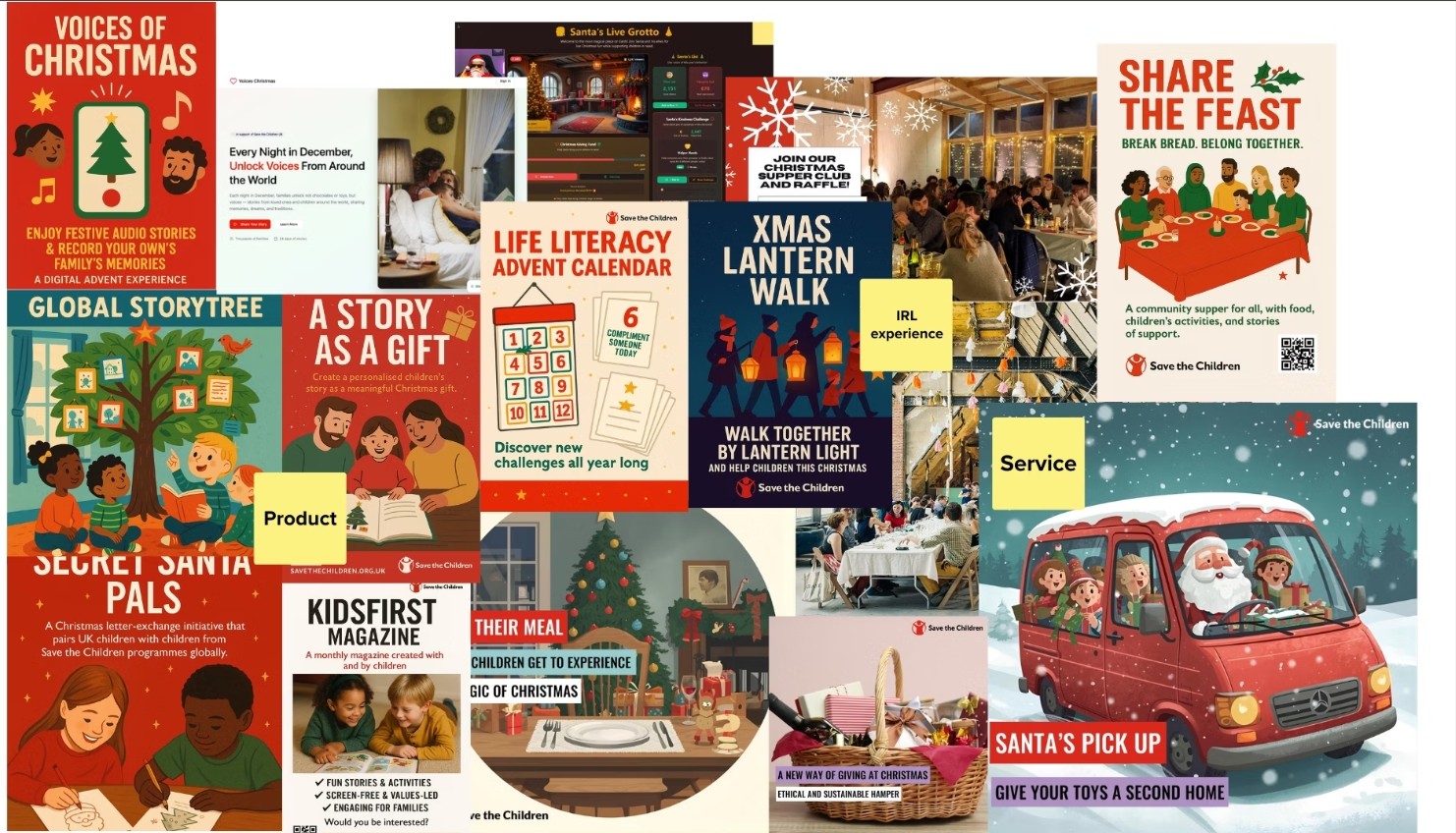
Research pointed to three opportunity spaces: Excess vs Real Value, Tradition vs New Rituals, and Escapism vs Reflection. Across 14 concepts, three finalists emerged: Santa’s Pick-Up, Christmas Grotto and Christmas Hamper. Santa’s Pick-Up proposed collecting unwanted toys and clothes from the doorstep—reducing waste and making generosity practical, useful and positive.
Approach
We reopened discovery instead of protecting the sunk cost of the near-launch proposition.
Research combined:
20 customer interviews
6 external expert interviews
5 internal PVH interviews
50+ market and research sources
~1,310 survey respondents across the UK, Netherlands, France and Germany
We mapped the riskiest assumptions, tested customer behaviour and market readiness, and used a two-day ideation process to turn the evidence into three possible routes:
01 — Partner with an existing multi-brand rental platform
Learn from real rental customers without building the infrastructure first.
02 — Explore a Tommy-led multi-brand proposition
Take greater ownership of the customer experience and business model.
03 — Explore physical rental / renewal experiences
Extend the proposition beyond online rental.
As the evidence developed, one principle became increasingly compelling:
Build less. Learn faster. Test through existing platforms first.
Experiments / Evidence
Evidence grew across distinct tests; these results are not one comparable funnel. Santa’s Pick-Up was the top choice in preference testing (n=58, 39.7%); it appeared in the top three for ~82% in the longlist test (n=60), and ~53% found it most interesting in the shortlist (n=45).
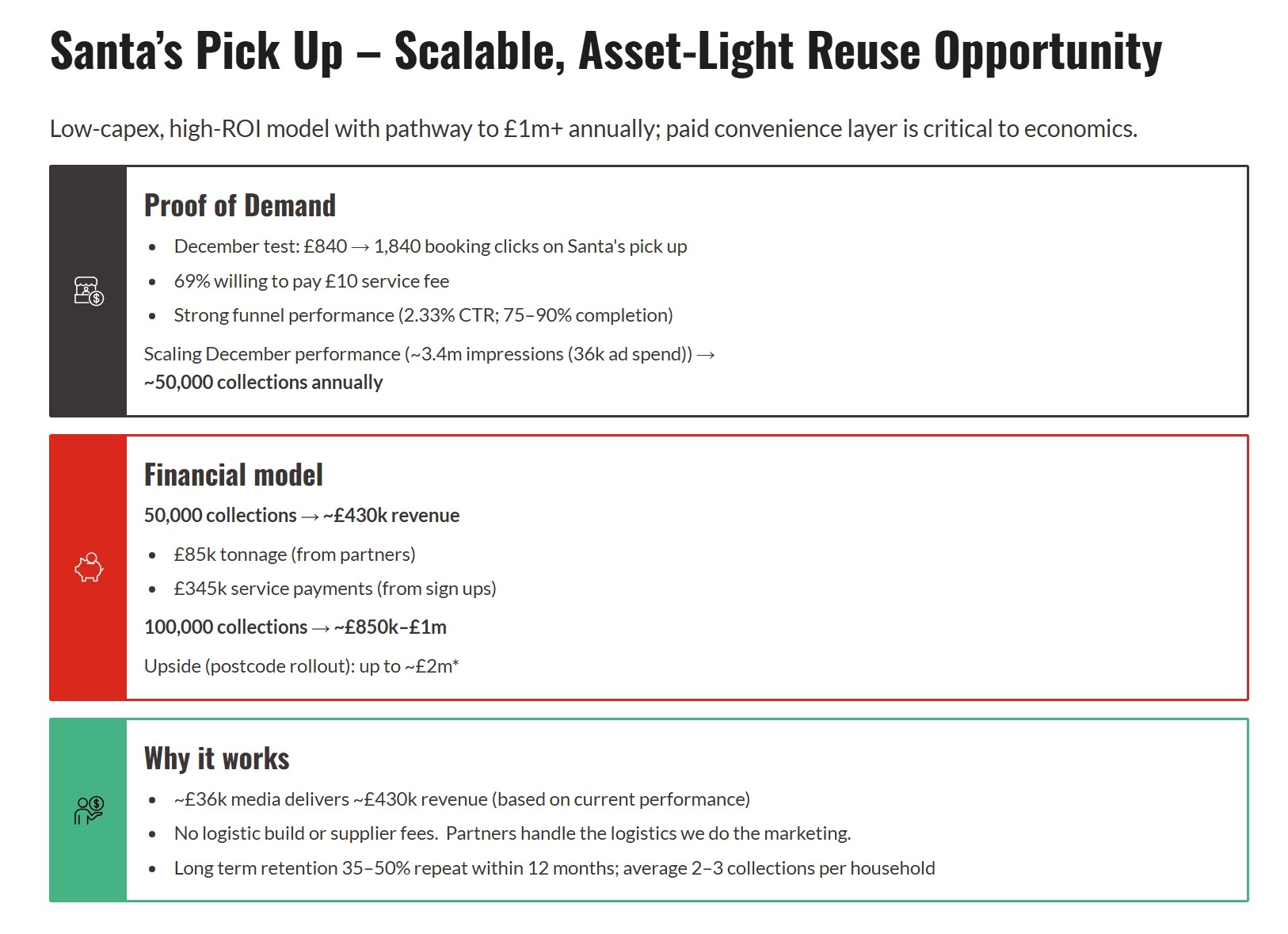
In a live three-option test, it received 70.7% of clicks (1,840), versus 21.4% for Hamper and 7.9% for Grotto. A higher-commitment test produced 213 sign-ups; ~69% chose £10 as fair, ~86% selected toys and games to donate, and ~93% said no to monthly giving.
The ~£800, nine-day Meta and landing-page test recorded 2.33% CTR, £0.25 per visit, ~£0.75 per intent click and ~£3 per survey completion. Three customer-care calls asked how to sign up; one other charity enquired. Seventeen unsolicited gifts totalled ~£300, not campaign ROI.
Compared with larger late-2025 Christmas Jumper Day and UK poverty-petition sign-up campaigns, Santa’s Pick-Up achieved higher CTR and lower click, visit, sign-up and PPC follow-up cost per qualified user. This indicates engagement efficiency, not fundraising performance or year-one return.
Outcome
GO to pilot with conditions.
GO TO CONTROLLED PILOT WITH CONDITIONS—not immediate scale. The asset-light model would let Save the Children focus on brand, acquisition and supporter experience while partners provide collection and resale infrastructure. The Modern Milkman confirmed willingness to work with Save the Children UK on a pilot; logistics, capacity and last-mile delivery remain to be tested. Other partners explored included DPD LOVE, Bag2Charity, Clothes for Charities, Roberts Recycling and Anglo. Partner benchmarks, not guaranteed project revenue: ~£400/week per active postcode once established; 12–15kg per completed collection; £200/tonne minimum payable; no charity fees; calibrated weighing and weighbridge reporting. Internal modelling only, subject to pilot: 50,000 collections could potentially generate ~£430k (~£85k goods income, ~£345k service payments); 100,000 could model ~£850k–£1m. Broader postcode benchmarks suggest potential towards ~£2m. None is realised revenue. The pilot must validate completion, kilograms per household, acquisition cost, donation quality, waste policy, trust, privacy, support burden, operational reliability and net income per pickup before any scale decision.
What I Learned
The brief is a hypothesis: evidence showed regular giving was not the natural Christmas ask, so we changed the question. Increasing commitment—from preference and ranking to click, booking intent, sign-up, willingness to pay and a proposed pilot—reduced uncertainty. Stopping weaker concepts as evidence improved helped reveal the strongest proposition. We did not start with Santa’s Pick-Up. We started with an assumption about Christmas giving. Audience evidence challenged it; successive experiments identified a stronger proposition and supported a controlled-pilot recommendation.
Key Metrics

What changed
We moved from an assumption about Christmas giving to behavioural evidence strong enough to justify a real-world pilot.